
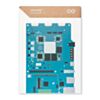
Arduino VENTUNO Q
An edge-AI computer pairing a 40 TOPS Qualcomm Dragonwing IQ8 with an STM32H5 microcontroller for on-device AI and real-time control.
In stock, ships same business day if ordered before 2PM
Delivered by Tue, 17th of Nov
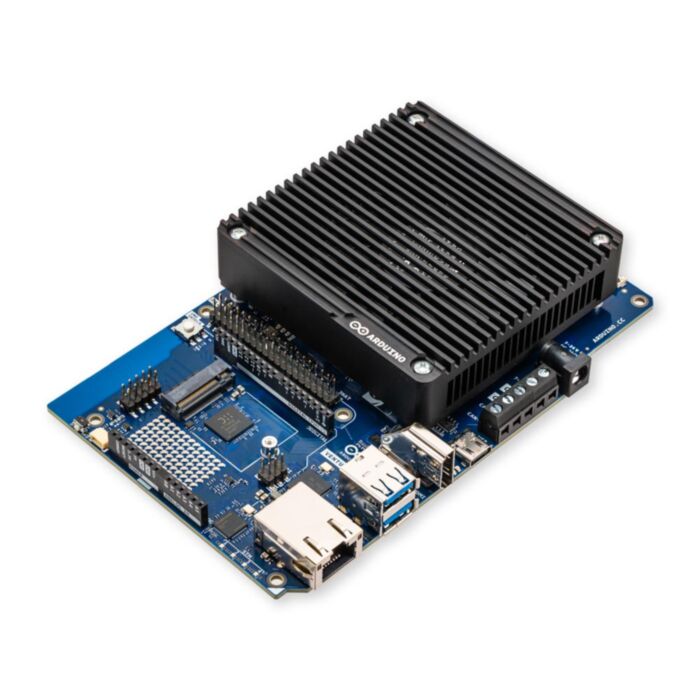
An edge-AI single-board computer that can see, understand, and physically respond to the world around it. Perception, decision-making and actuation all happen on the board, with no cloud dependency and no data leaving the device.
Two processors with different purposes share the work over a high-speed RPC bridge. A Qualcomm Dragonwing IQ8 (IQ-8275) with an 8-core ARM CPU, an Adreno GPU, Spectra 692 ISP, and a Hexagon NPU rated at up to 40 dense TOPS, all on one SoC, runs your neural networks, vision pipelines and language models. Alongside it, an STM32H5F5 Cortex-M33 runs the Arduino core on Zephyr for sub-millisecond, deterministic control of motors, robots and industrial I/O. On-device intelligence and real-time actuation usually take two separate systems; here they share one 160 × 100 mm board.
Everything is developed in Arduino App Lab, where Arduino sketches, Python scripts, Linux applications and AI models sit side by side. Use the board as a standalone computer with a monitor, keyboard and mouse on an Ubuntu or Debian desktop, or connect from your existing laptop over USB-C or Ethernet.
It works with hardware you may already own: Arduino UNO shields on the UNO headers, Raspberry Pi HATs on the standard 40-pin GPIO header, and Qwiic, PiicoDev, STEMMA QT and Modulino I2C modules through the solder-free Qwiic connector. Plan for around 25 W of power draw: through USB-C PD, a barrel jack or the screw terminals.
We recommend a 12 V Power Supply, along with a compatible IEC adapter, or, once set up, a 65+ W USB-C supply and a high-quality USB-C cable.
Features
Runs language, vision-language and speech models fully offline, with a curated library that includes Qwen LLM and VLM, Whisper transcription and Melo TTS
Recognises gestures, tracks objects and detects poses on-device using ready-to-run MediaPipe, YOLO-X and PoseNet models
Gets complex systems prototyped quickly with App Lab Bricks: reusable blocks for IoT endpoints, audio and image recognition, database queries and more
Keeps actuator control deterministic, with native ROS 2 support and GPIO, PWM and CAN-FD handled by the dedicated real-time microcontroller
Connects to industrial and vehicle networks through five CAN-FD channels, one with an onboard transceiver on a screw terminal
Moves data quickly over 2.5 Gb Ethernet, Wi-Fi 6 and Bluetooth 5.3, with onboard antennas
Handles several cameras and displays at once via MIPI-CSI, USB cameras, HDMI or MIPI-DSI, and DisplayPort Alt Mode over USB-C
Expands storage beyond the 64 GB eMMC with an M.2 2230 slot for an NVMe Gen 4 SSD
Supports custom carrier designs, with high-speed JMEDIA, JOMEGA and JMISC headers for cameras, displays, audio and extra USB and CAN
Arduino VENTUNO Q Specifications
Property | Value |
|---|---|
AI processor (MPU) | Qualcomm Dragonwing IQ8 (IQ-8275): 8-core ARM CPU, Adreno GPU @ 877 MHz, Hexagon NPU up to 40 dense TOPS, Spectra 692 ISP |
Operating system | App Lab running on Ubuntu or Debian |
Microcontroller (MCU) | STM32H5F5 ARM Cortex-M33 @ 250 MHz, 4 MB flash, 1.5 MB RAM; Arduino core on Zephyr |
Memory | 16 GB LPDDR5 |
Storage | 64 GB eMMC; add your own with the M.2 connector for NVMe Gen 4 SSD (2230) |
Wireless | Wi-Fi 6 (2.4/5/6 GHz), Bluetooth 5.3, onboard antennas |
Wired networking | 1 × 2.5 Gb Ethernet (RJ45) |
Cameras | USB camera support; 3 × MIPI-CSI (muxed with 2 more on JMEDIA header) |
Display | HDMI (muxed with MIPI-DSI), USB-C DisplayPort Alt Mode, MIPI-DSI on JMEDIA |
Audio | 2 × mic in, headphone, ear and line out on JMISC header |
USB | 1 × USB-C (host/device/power role switching, video), 2 × USB 3.0 Type-A, 2 × USB 3.0 on JOMEGA header |
CAN | 1 × CAN-FD with PHY (screw terminal), 3 × CAN-FD on JOMEGA, 1 × CAN-FD on the UNO shield headers |
Expansion | Arduino UNO shield headers, 40-pin Raspberry Pi HAT-compatible GPIO header, Qwiic connector, JMEDIA, JOMEGA and JMISC headers |
Power input | USB-C 9-20 V, 3 A 5.5 × 2.1 mm jack 12-24 V, 5 A max Screw terminal 7-24 V, 10 A max |
Power consumption | Approximately 25 W+ during typical use, a 60 W+ supply is recommended |
Dimensions | 160 × 100 × 25.8 mm |
Resources
VENTUNO Q Tutorials (Arduino Docs)
Official 3D-Printable Enclosure Case (Printables): prints in PLA, PETG or ABS and assembles with 10 × M3 × 6 mm flathead screws
This product is listed in:
Arduino>BoardsArduino>Boards>Core Boards
Home Lab>Machine Learning
Development Boards>Single Board Computers
Exact shipping can be calculated on the view cart page (no login required).
Products that weigh more than 0.5 KG may cost more than what's shown (for example, test equipment, machines, >500mL liquids, etc).
We deliver Australia-wide with these options (depends on the final destination - you can get a quote on the view cart page):
- $3+ for Stamped Mail (typically 10+ business days, not tracked, only available on selected small items)
- $7+ for Standard Post (typically 6+ business days, tracked)
- $11+ for Express Post (typically 2+ business days, tracked)
- Pickup - Free! Only available to customers who live in the Newcastle region (must order online and only pickup after we email to notify you the order is ready). Orders placed after 2PM may not be ready until the following business day.
Non-metro addresses in WA, NT, SA & TAS can take 2+ days in addition to the above information.
Some batteries (such as LiPo) can't be shipped by Air. During checkout, Express Post and International Methods will not be an option if you have that type of battery in your shopping cart.
International Orders - the following rates are for New Zealand and will vary for other countries:
- $12+ for Pack and Track (3+ days, tracked)
- $16+ for Express International (2-5 days, tracked)
If you order lots of gear, the postage amount will increase based on the weight of your order.
Our physical address (here's a PDF which includes other key business details):
40 Aruma Place
Cardiff
NSW, 2285
Australia
Take a look at our customer service page if you have other questions such as "do we do purchase orders" (yes!) or "are prices GST inclusive" (yes they are!). We're here to help - get in touch with us to talk shop.
Have a product question? We're here to help!
 Arduino UNO Q - 2GBSKU: ABX00162 Brand: Arduino
Combining a high-performance Linux CPU with real-time control - capable of ru ...
- Raspberry Pi 5 Model B 16GBSKU: CE10111 Brand: Raspberry Pi
The 16GB Raspberry Pi 5 packs the most power and onboard memory in the Raspbe ...
- Raspberry Pi AI HAT+ 2SKU: CE10475 Brand: Raspberry Pi
A powerful and versatile machine learning HAT for the Pi 5 - run LLMs, VLMs a ...
- Raspberry Pi 5 Model B 8GBSKU: CE09786 Brand: Raspberry Pi
The 8GB Raspberry Pi 5 is the latest powerhouse in the Raspberry Pi lineup. I ...


Videos
View AllGuides

Getting Started with the NVIDIA DGX Spark | Local LLMs & NIM

Arduino Uno Q Explained | A Hybrid Linux and Microcontroller Dev Board
How to Reinstall Linux on the Uno Q | Arduino Reflashing Guide
Getting Started with the Arduino Uno Q
Projects
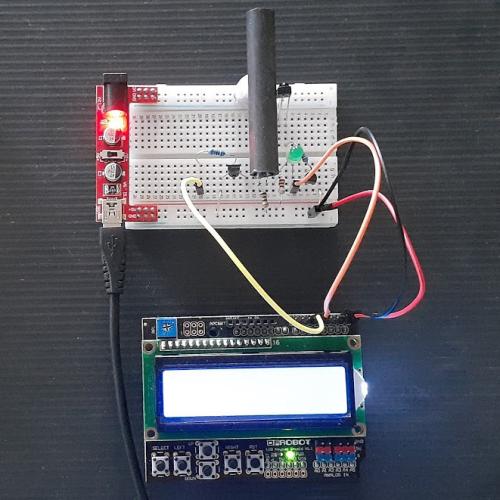
IR Break-Beam Stopwatch

Ping Pong Launcher
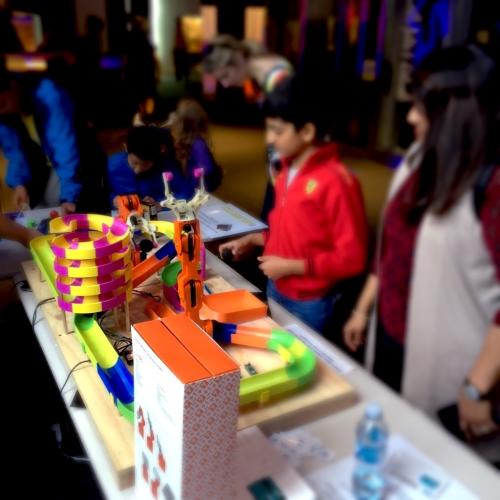
The Hipster Coaster
Educational Workshops
Arduino Workshop for Beginners

Makers love reviews as much as you do, please follow this link to review the products you have purchased.
Product Comments