
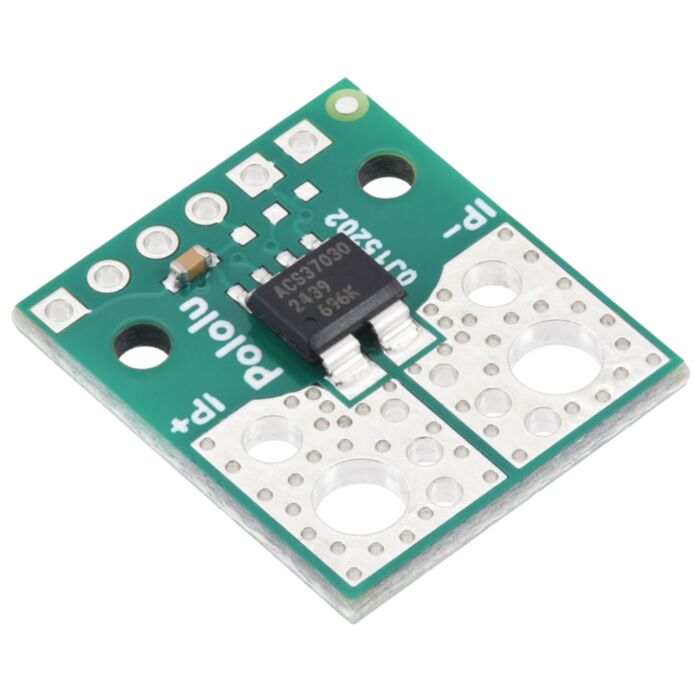
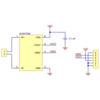
ACS37030LLZATR-020B3 Current Sensor Compact Carrier -20A to +20A, 3.3V
Available with a lead time
Expect dispatch between Oct 28 and Nov 02
Quantity Discounts:
- 10+ $17.50 (exc GST)
- 25+ $16.95 (exc GST)
 |
 |
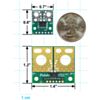
| ACS37030 Current Sensor Compact Carrier (top) and Large Carrier (bottom) size comparison. |
|---|
Pololu are offering these breakout boards with support from Allegro Microsystems as an easy way to use or evaluate their ACS37030 DC to 5 MHz bandwidth, galvanically isolated, high-accuracy current sensors with reference output; Pololu therefore recommend careful reading of the ACS37030 datasheet before using this product. The following list details some of the sensor’s key features:
- Electrically isolated current path allows the sensor to be inserted anywhere along the current path and to be used in applications that require electrical isolation.
- High bandwidth (DC to 5 MHz) analog voltage output proportional to the current.
- 40 ns typical response time.
- Two current signal paths:
- Hall effect-based sensor for capturing DC and low-frequency current information
- Inductive coil for capturing high-frequency current information.
- 0.7 mO primary current path resistance in the sensor IC, and the PCB is made with 2-layer (compact versions) or 6-layer (large versions) 2-oz copper, so very little power is lost in the module.
- Differential Hall sensing rejects common-mode fields, so the orientation of the sensor relative to uniform external magnetic fields (e.g. the Earth’s magnetic field) has less effect on the measurement.
- Output is not ratiometric (i.e. the zero point and sensitivity are independent of the actual supply voltage), which provides immunity from noisy supplies.
- VREF output for pseudo-differential signaling in noisy application environments.
- Integrated digital temperature compensation circuitry allows improved accuracy over the full operating temperature range.
- Automotive-grade operating temperature range of -40°C to 150°C.
- Carrier boards, available in compact and large sizes, offer a variety of ways to insert it into the current path along with 0.1"-pitch (breadboard-compatible) power, ground, and output pins.
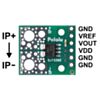
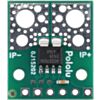
The connection points are labeled on the silkscreen, which is on the bottom side of the compact versions and on both sides of the large versions. The bottom silkscreen also shows the direction that is interpreted as positive current flow via the +i arrow.
The following table lists the available ACS37030 carrier options:
| Pololu Item # | Part Suffix | Current Range | Sensitivity (mV/A) | Size | PCB Details | |
|---|---|---|---|---|---|---|
 Compact Carrier | #5230 | 020B3 | ±20 A | 66 | 0.7"×0.8" | 2 layers, 2-oz copper |
| #5232 | 065B3 | ±65 A | 20.3 | |||
 Large Carrier | #5235 | 065B3 | ±65 A | 20.3 | 1.4"×1.2" | 6 layers, 2-oz copper |
Details for item #5230
|
|


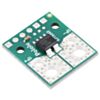
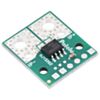
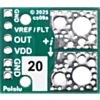
This compact carrier features the ACS37030LLZATR-020B3, which is intended for nominal 3.3 V operation and is designed for bidirectional input current from -20 A to +20 A. This version can be visually distinguished from the other versions by the “20” printed on the bottom side, as shown in the left picture above.
| Part Suffix | Range | Supply Voltage | Sensitivity | Zero Point | Size | PCB layers |
|---|---|---|---|---|---|---|
| 020B3 | ±20 A (bidirectional) | 3 V to 3.6 V | 66 mV/A | 1.65 V | 0.7"×0.8" | 2 |
Using the sensor
 |
This sensor has five required connections: the input current (IP+ and IP-), logic power (VDD and GND), and the sensor output (VOUT).
The sensor requires a supply voltage of 3.0 V to 3.6 V to be connected across the VDD and GND pads, which are labeled on the bottom silkscreen. The sensor outputs an analog voltage on VOUT that is centered at 1.65 V and changes by 66 mV per amp of input current, with positive current increasing the output voltage and negative current decreasing the output voltage:
The output is not ratiometric, so the zero point and sensitivity are independent of the actual supply voltage.
The zero-current reference voltage, which is available on VREF, can be used to reduce errors due to reference shifts or noise on the ground line.
Making connections to the board
 |
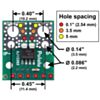
You can insert the board into your current path in a variety of ways. For typical high-current applications, you can solder wires directly to the through-holes that best match your wires, or you can use solderless ring terminal connectors. The largest through-holes are big enough for 10 AWG wires or #6 or M3.5 screws, and the second-largest through-holes (and mounting holes) are sized for 14 AWG wires or #2 or M2 screws. Holes with 0.1", 3.5 mm, and 5 mm spacing are also available as shown in the diagram above for connecting male header pins or terminal blocks, but please note that these connection options will generally not be suitable for the kinds of high currents intended for this sensor. The pictures below show examples of various connection options with the ACS37220 compact carrier, which has the same physical dimensions as the ACS37030 compact carrier.
|
| ||
|
|


The VREF, VOUT, VDD, and GND pins work with 0.1"-pitch header pins and are compatible with standard solderless breadboards
Warning: This product is intended for use below 30 V. Working with higher voltages can be extremely dangerous and should only be attempted by qualified individuals with appropriate equipment and experience.
Schematic and dimension diagrams
 |
| ACS37030 Current Sensor Carrier schematic diagram. |
|---|
The dimension diagram is available as a downloadable PDF (421k pdf).
Real-world power dissipation considerations
 |
| Thermal image of a high-current test of a Pololu current sensor carrier (not necessarily this product). |
|---|
Depending on the version, the ACS37220 can measure up to ±65 A. However, the sensor chip can overheat at lower currents. In Pololu's tests, Pololu found that the ACS37030 compact carrier boards could conduct about 55 A continuously without reaching the thermal limit for the IC. Pololu's tests were conducted at approximately 25°C ambient temperature with no forced air flow.
The actual current you can pass through the sensor will depend on how well you can keep it cool. The carrier’s printed circuit board is designed to help with this by drawing heat out of the sensor chip. Solid connections to the current path pins (such as with thick soldered wires or large, tightly-secured lugs) can also help reduce heat build-up in the sensor and carrier board, as can switching to the equivalent large carrier version.
Warning: Exceeding temperature or current limits can cause permanent damage to the sensor. If you are measuring an average continuous current greater than 45 A, Pololu strongly recommend that you monitor the sensor’s temperature and look into additional cooling if necessary.
This product can get hot enough to burn you long before the chip overheats. Take care when handling this product and other components connected to it.
Comparison of the Pololu current sensor carriers
Pololu have a variety of current sensors available with different ranges, sensitivities, and features. The table below summarizes Pololu's selection of active and preferred options:


(1) Sensitivity when Vcc = 3.3 V; actual sensitivity is ratiometric (i.e. it is proportional to Vcc).
(2) Sensitivity when Vcc = 5 V; actual sensitivity is ratiometric (i.e. it is proportional to Vcc).
(3) Bandwidth can be reduced by adding a filter capacitor.
(4) 50A version uses 4-oz copper PCB; all other versions use 2-oz copper.
(5) 50A and higher versions use a 4-layer PCB; all other versions use a 2-layer PCB.
Dimensions
| Size: | 0.7" × 0.8" |
|---|---|
| Weight: | 1.2 g |
General specifications
| Typical operating voltage: | 3.3 V |
|---|---|
| Current sense: | 66 mV/A |
| Minimum logic voltage: | 3.0 V |
| Maximum logic voltage: | 3.6 V |
| Supply current: | 20 mA1 |
| Current range: | -?20A to +20A (bidirectional 20A), 3.3V |
| Current sensor: | Allegro ACS37030LLZATR-020B3 |
Identifying markings
| PCB dev codes: | cs09a |
|---|---|
| Other PCB markings: | 0J15202 |
| Other PCB markings: | 20 |
Notes:
File downloads
-
Dimension diagrams of the ACS37030 Current Sensor Carriers (421k pdf)
-
3D model of the ACS37030 Current Sensor Compact Carriers (3MB step)
-
Drill guide for the ACS37030 Current Sensor Compact Carriers (19k dxf)
This DXF drawing shows the locations of all of the board’s holes.
Recommended links
-
Allegro product page for the ACS37030 5 MHz Current Sensor
Allegro product page for the ACS37030, where you can find additional application notes and other resources.
Exact shipping can be calculated on the view cart page (no login required).
Products that weigh more than 0.5 KG may cost more than what's shown (for example, test equipment, machines, >500mL liquids, etc).
We deliver Australia-wide with these options (depends on the final destination - you can get a quote on the view cart page):
- $3+ for Stamped Mail (typically 10+ business days, not tracked, only available on selected small items)
- $7+ for Standard Post (typically 6+ business days, tracked)
- $11+ for Express Post (typically 2+ business days, tracked)
- Pickup - Free! Only available to customers who live in the Newcastle region (must order online and only pickup after we email to notify you the order is ready). Orders placed after 2PM may not be ready until the following business day.
Non-metro addresses in WA, NT, SA & TAS can take 2+ days in addition to the above information.
Some batteries (such as LiPo) can't be shipped by Air. During checkout, Express Post and International Methods will not be an option if you have that type of battery in your shopping cart.
International Orders - the following rates are for New Zealand and will vary for other countries:
- $12+ for Pack and Track (3+ days, tracked)
- $16+ for Express International (2-5 days, tracked)
If you order lots of gear, the postage amount will increase based on the weight of your order.
Our physical address (here's a PDF which includes other key business details):
40 Aruma Place
Cardiff
NSW, 2285
Australia
Take a look at our customer service page if you have other questions such as "do we do purchase orders" (yes!) or "are prices GST inclusive" (yes they are!). We're here to help - get in touch with us to talk shop.
Have a product question? We're here to help!
 DC-DC Power Module 25WSKU: DFR0205 Brand: DFRobotThis Power Module is a small size 5A 350KHz 25V Buck DC to DC Converter.It can c ...
- Rocker Switch - Round w/ Blue LEDSKU: COM-11155 Brand: SparkfunThese panel-mounting rocker switches have built-in indicator lights to let you k ...
- Mini Illuminated Momentary Pushbutton - Blue Power SymbolSKU: ADA3105 Brand: AdafruitThis Mini Illuminated Momentary Power Button is an adorable breadboard-friendly ...
- Adafruit Power Relay FeatherWingSKU: ADA3191 Brand: Adafruit FeatherA Feather board without ambition is a Feather board without FeatherWings! This i ...


Videos
View AllGuides

The Maker Revolution

Getting Hands-on with Sensors
Projects
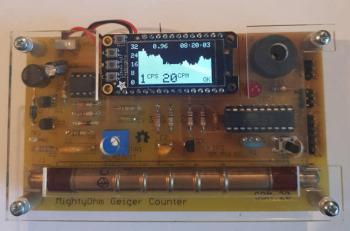
WhyzaGC - Feather ESP32 addon to the MightyOhm Gieger Counter

Makers love reviews as much as you do, please follow this link to review the products you have purchased.
Product Comments